
The first thing most people notice about Lake Keowee is the color of the water. It is a clear blue-green that reads as out of place in the Southeast, closer to something you would expect in the mountains of the West, and it holds that color deep into the summer. The second thing they notice is what is missing from the shoreline. There are no towers, no continuous wall of rooftops, no marina-and-condo corridor running cove to cove. Duke Energy has controlled development along these 300-plus miles since the lake filled in the early 1970s, and the effect of fifty years of that discipline is a lake that still looks largely like itself.
Those two observations account for a good deal of why people end up here. Lake Keowee has become one of the more sought-after relocation destinations in Upstate South Carolina, and many of the buyers who choose it tend to arrive by way of comparison. They have looked at Lake Tahoe, at the North Georgia lakes, at Lake Norman, at the western North Carolina mountain markets, and at coastal options in both Carolinas. They arrive with a spreadsheet and a set of questions.
What follows is written for people looking for Lake Keowee luxury homes for sale and wondering about the buying process: buyers weighing a move from Atlanta or Charlotte, families relocating from Florida or the Northeast, and owners considering whether a second home here eventually becomes the primary one. It covers the practical questions, drive times and airports, cost of living and taxes, healthcare, climate, and the differences among the communities, alongside the ones that are harder to answer from a distance, like what a given stretch of shoreline is actually like on a Saturday in July.
Lake Keowee suits a particular kind of buyer very well, and less well for others. Someone who wants shopping, dense amenities, and a short walk to nightlife will likely be happier elsewhere. Someone who wants clear water, mountains at the north end, a college town 20 minutes away, and a shoreline that will probably look much the same fifteen years from now will find that combination difficult to replicate anywhere else in the region.
Why People Relocate to Lake Keowee
Lake Keowee sits in northwest South Carolina, in an area Palmetto State residents call the Upstate (A.K.A. South Carolina’s Golden Corner). It was created by Duke Energy in the early 1970s as part of the Keowee-Toxaway hydroelectric project, and that origin story explains a great deal about why the lake looks the way it does today.
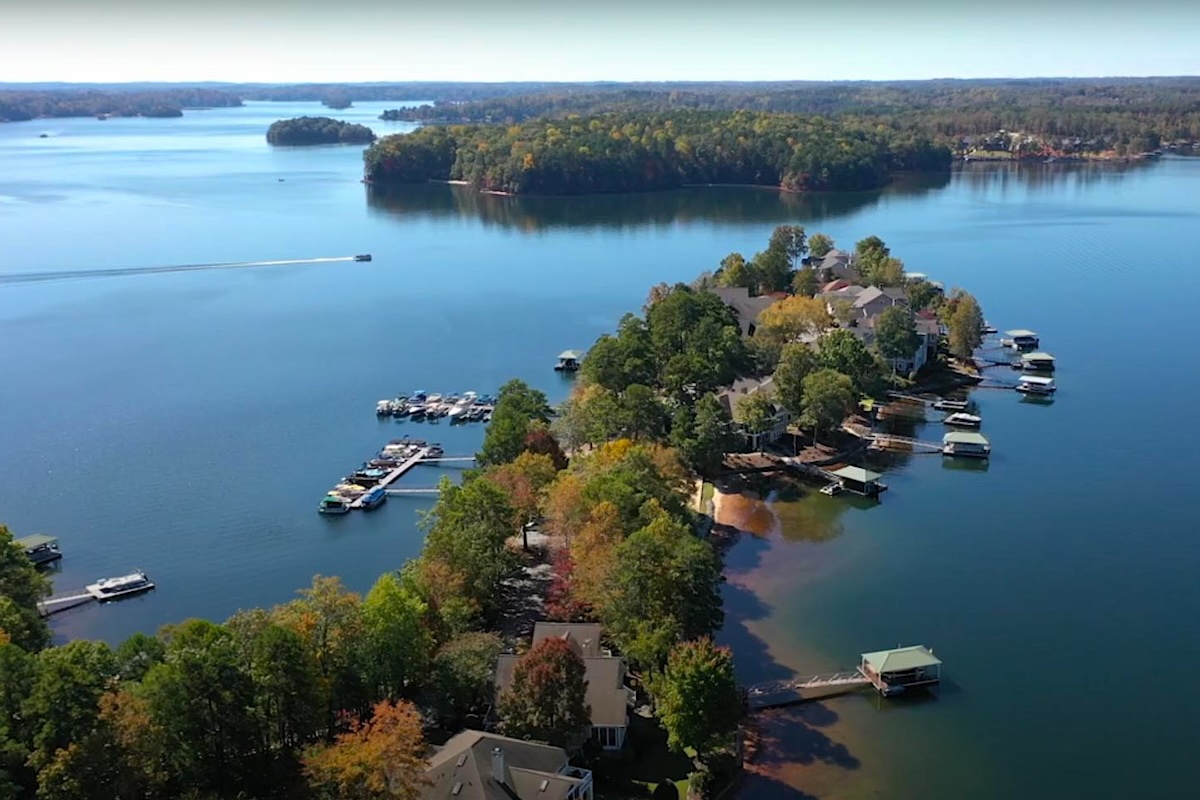
The water comes off the mountain watershed above it, including releases from Lake Jocassee, which is a significant reason Keowee has a reputation for clarity that few Southeastern reservoirs can match. People compare it to Lake Tahoe often enough that the nickname has stuck.
Duke Energy still owns and manages the shoreline, and development along those 300-plus miles has been controlled from the beginning. The practical result is a lake ringed largely with lower-density single-family homes, protected coves, and long stretches of undeveloped Sumter National Forest frontage rather than wall-to-wall construction.

The people who move to Lake Keowee fall into a few broad groups. Retirees and near-retirees make up a large share, drawn by the climate, the healthcare access in Seneca and Greenville, and the fact that a lake house here can work year-round. Second-home buyers from Atlanta and Charlotte want a place close enough to reach on a Friday evening. Remote workers have become a growing segment, and broadband availability is best checked address by address around the lake. And there is a distinct Clemson contingent: alumni, parents, and retired faculty who want to be near the university without living in town.
Getting Here: Drive Times and Airports
One of Lake Keowee’s underrated advantages is how central it is to the Southeast. You can reach several major metros in a morning, which matters whether you are commuting occasionally, hosting family, or keeping a business relationship alive in the city you left.
Driving Distances
These are approximate and assume you are heading toward the Seneca or Salem side of the lake. Traffic on I-85 through Greenville and Atlanta can add meaningfully to the longer routes.
- Clemson: roughly 15 to 20 minutes from much of the southern shoreline
- Greenville: about 45 minutes to an hour
- Asheville: under two hours through the mountains
- Charlotte: roughly two hours via I-85
- Atlanta: roughly two and a half hours via I-85
- Columbia: about two hours
- Charleston: about four hours
- Jacksonville: about five hours
Flying In
Greenville-Spartanburg International (GSP) in Greer is the closest commercial airport, typically under an hour from the lake, and it carries nonstop service to many major hubs. Many owners who fly in regularly settle on GSP for exactly that reason: you can land and be on your dock inside of ninety minutes.
Charlotte Douglas is roughly two hours away and gives you an international hub with far more nonstop options, which tends to matter for Northeastern owners and anyone flying overseas. Hartsfield-Jackson in Atlanta is a similar drive. Asheville Regional is closer than either and useful for regional connections. There is also general aviation service at Oconee County Regional Airport in Clemson and Pickens County Airport for private aircraft.
Getting Around Once You Are Here
Seneca is the commercial hub for the lake and handles most of what you need day to day: groceries, hardware, medical offices, restaurants, and the bulk of the retail in Oconee County. Salem sits closer to the northern end of the lake near Keowee Key and the Cliffs communities, smaller and quieter, with Devils Fork State Park and Lake Jocassee just up the road. Walhalla is the Oconee County seat, West Union is a smaller town worth knowing, and Mountain Rest takes you up into the mountains toward the Chattooga River. Six Mile sits over on the Pickens County side.
Clemson gives you a university town’s amenities at close range. Greenville, which has spent two decades turning its downtown into one of the more appealing city centers in the Southeast, is a comfortable day trip for dinner, the arts, or a bigger shopping run.
What Changes When You Move to Lake Keowee?
Climate and Four Seasons

Upstate South Carolina gives you four distinct seasons without the punishing length of a Northern winter. Summers are hot and humid, though the lake and the elevation take some edge off compared to the Midlands or the coast. Fall is the season people fall in love with: the Blue Ridge color comes down through October and November, and the water stays warm enough to use well past Labor Day.
Winters are mild by most standards. Hard freezes happen, occasional snow happens, but the lake does not freeze and boats often stay in the water year-round. Spring arrives early, usually with dogwood and mountain laurel through the shoreline woods by late March.
Cost of Living
Compared with the major metros feeding this market, Oconee and Pickens County costs are generally lower across groceries, services, fuel, and labor. Waterfront real estate on Lake Keowee is priced as the scarce asset it is, so buyers coming from more expensive markets often find they can trade up substantially on the house while their monthly carrying costs outside the mortgage go down. Buyers coming from lower-cost areas should expect waterfront pricing to run well above the regional median.
How South Carolina Treats Primary Versus Second Homes
South Carolina assesses owner-occupied primary residences at a lower ratio than second homes and rental property, and there are additional relief programs that can apply to qualifying seniors, disabled homeowners, and veterans. Your final bill depends on that classification combined with the millage for the specific taxing districts covering the address.
Worth verifying before you write an offer: assessment ratios, millage, and relief programs are administered at the county level and can change. Oconee County and Pickens County handle this separately, so a home on one side of the lake can carry a different bill than a comparable home on the other. Confirm the current numbers with the applicable county assessor, or with an agent who can pull the record for a specific parcel, before you rely on an estimate.
Healthcare and Medical Access
For a rural county, Oconee is well served. Prisma Health Oconee Memorial Hospital in Seneca covers emergency and general hospital care, with a network of affiliated practices and specialists around it. For anything more specialized, Greenville is inside an hour and has multiple major hospital systems, including academic and cardiac care. This combination is one of the more common reasons retirement-age buyers choose Keowee over more remote mountain markets.
Clemson University and the Cultural Draw
Clemson shapes the area more than its size suggests. Football Saturdays reorganize the whole region in the fall, and many lake owners plan their calendars around home games. Beyond athletics, the university brings lecture series, performing arts, continuing education programs aimed at retirees, and a steady flow of visiting family that gives lake houses here a purpose beyond vacation.
Choosing Where to Live
Lake Keowee is often discussed as a single destination, though in practice it functions as a collection of distinct residential environments.
Gated Communities Versus Independent Shoreline
The gated communities around Keowee offer amenity packages, architectural review, security, and a built-in social structure. That last piece can matter a great deal if you are moving somewhere you do not know anyone, and it is a common reason relocating buyers gravitate toward them.
Independent shoreline outside the gates trades those amenities for autonomy and typically lower ongoing dues. Some of the most private property on the lake sits outside any community, and buyers who mainly want water, quiet, and a dock frequently prefer it.
Waterfront, Interior, and Lake Access
Waterfront with a permitted dock is the premium category and prices accordingly. Interior homes inside an established community give you club amenities, marina access, and lower shoreline upkeep, which suits owners who boat occasionally rather than daily.

Lake-access properties fall between the two, often with deeded or assigned slips. The distinctions among deeded, assigned, and no slip rights are important enough to confirm in writing during due diligence.
The Oconee Side Versus the Pickens Side
The lake spans both counties. Oconee County holds the larger share of shoreline, Seneca and Salem, and most of the established communities. The Pickens County side runs toward Six Mile and sits closer to Clemson. The counties differ in millage, school districts, and some overlay and buffer requirements, so comparing two similar homes across the county line means comparing two different sets of local specifics.
The Main Communities at a Glance

Keowee Key is the original and most established community on the lake, on a peninsula near Salem, with an 18-hole golf course, two marinas, tennis and pickleball, indoor and outdoor pools, clubhouse dining, and a leisure trail. It runs on a POA structure and has a mature, socially active feel that many relocating buyers find easy to plug into.
The Reserve at Lake Keowee is a private waterfront community on the eastern side of the lake with a Jack Nicklaus Signature golf course, the Orchard Clubhouse, a marina, tennis, and a village center. It reads as resort-forward and walkable.
The Cliffs maintains several enclaves around Keowee, including Keowee Springs, Keowee Falls (South and North), and Keowee Vineyards, each with its own character and amenities. Springs is known for its beach club and Tom Fazio course, and draws a lot of families. Vineyards has a full-service marina and the muscadine vineyards the name refers to. Cliffs membership can carry access across the broader portfolio of communities.
Smaller communities including Waterford Pointe, Waterside Crossing, and Cross Creek Plantation in Seneca offer more intimate settings, generally with lighter amenity structures and lower dues.
If You Are Coming From Atlanta
You already know the lake calculus in North Georgia. Lanier on a July Saturday is a contact sport, Burton and Rabun are lovely, tightly held, and priced accordingly, and anything quiet enough to hear a heron land means driving deep into the mountains where the water gets small and the drive gets long.
Keowee resolves that math differently. From Buckhead or Sandy Springs you are looking at roughly two and a half hours up I-85, past Commerce, past the Tanger outlets, over the Tugaloo, and off at Fair Play or Highway 11. That is close enough to leave after work on Friday and be on the water before dark. It is also more than enough distance that you have unmistakably left metro Atlanta.
What Atlanta buyers notice first is usually the water itself. Keowee’s clarity and the mountain backdrop over the northern end read as something closer to the North Carolina mountains than to a Georgia reservoir, and you are getting it with 18,500 acres of open water rather than a cove off a river channel. The traffic density is a different world: there are summer weekends on Keowee where you can idle out of a cove in Salem and see four boats.
The practical draws beyond the water are Clemson, which puts major college football twenty minutes from your dock, and Greenville, which many Atlanta transplants describe as the downtown they wish they could drive to in fifteen minutes. Seneca handles the everyday errands. Highway 11, the Cherokee Foothills Scenic Highway, runs along the top of the lake toward Table Rock and Caesars Head, and you get the waterfalls of Oconee County and Lake Jocassee at Devils Fork essentially in your backyard.
Atlanta buyers on Keowee tend to fall into two groups: weekend owners who eventually go full-time, and buyers who intend to retire here and start early. If you are in the first group, pay close attention to how a given community handles lock-and-leave ownership and whether short-term rental use is permitted, because that varies considerably around the lake.
If You Are Coming From Florida
Florida to the Carolinas has been one of the steadier migration paths in the country for years, and Lake Keowee captures a meaningful share of it. The reasons Florida buyers give tend to cluster around a few things.
Elevation and seasons naturally come up first. The lake sits around 800 feet, in the foothills, and you get a fall here: color coming down the ridges through late October, cool mornings, a reason to own a fireplace. After a decade or two of the Gulf Coast or Central Florida, buyers describe that as the thing they missed without knowing they missed it. Summer is still hot in Upstate South Carolina, though the nights cool off in a way they certainly do not in Tampa or Naples.
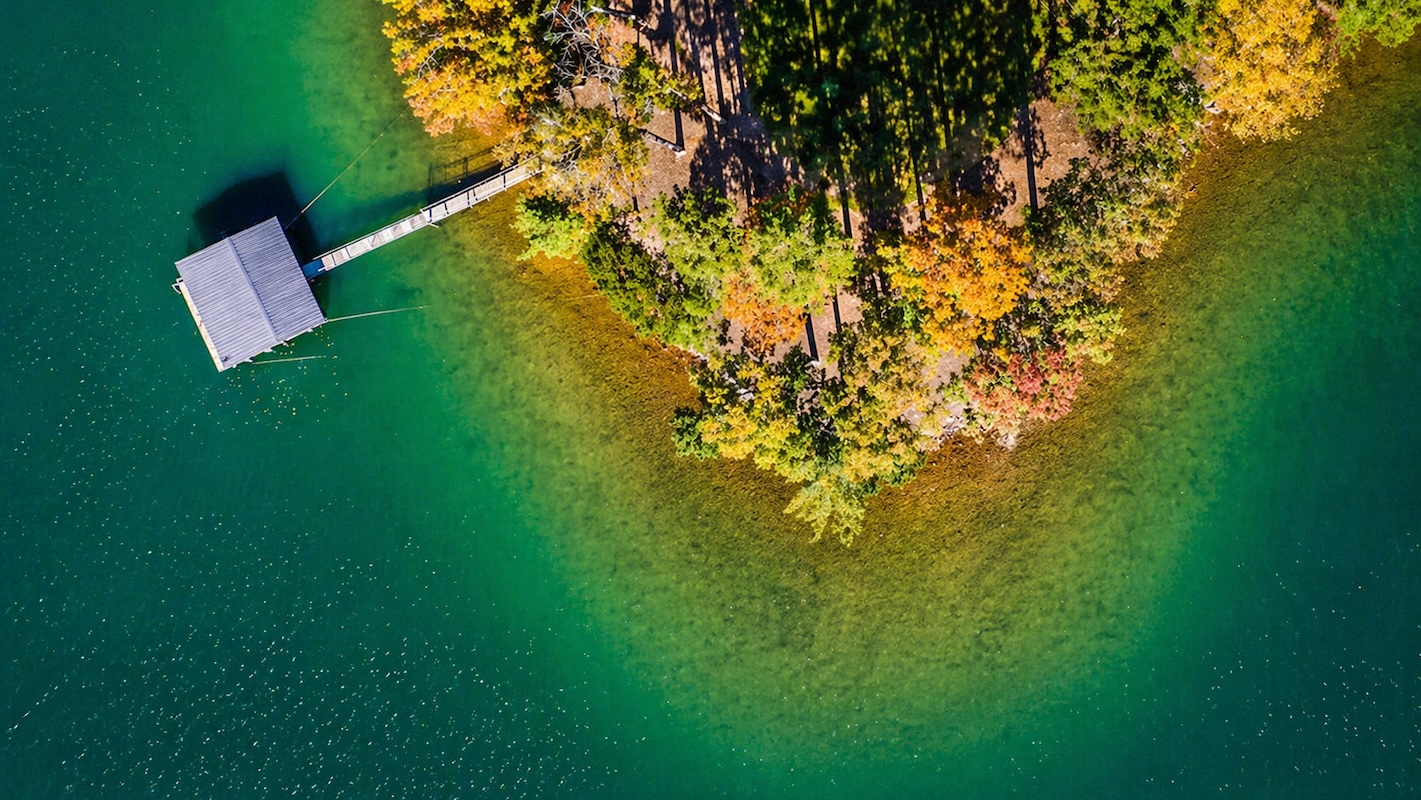
Then there is the water itself. Keowee is fresh, deep, clear, and mountain-fed. Salt drops out of the equation entirely: no corrosion on the hull, no barnacles, no red tide closing the beach, no storm surge in the forecast. Docks on Keowee are permitted through Duke Energy and built for a managed reservoir where levels fluctuate seasonally, which is a different maintenance picture than coastal Florida waterfront and generally a gentler one.
Hurricane exposure is the other half of that conversation. Upstate South Carolina is roughly 250 miles inland with the Blue Ridge to the north. Tropical systems do reach here, and they arrive as rain and wind events rather than the coastal threat Florida owners are used to planning around. Buyers relocating from the Gulf Coast often say the insurance and preparation math is the clearest single improvement in their situation.
The drive is about 6 hours from Jacksonville, closer to 8 from Orlando, 8 and a half from Tampa, and 10-11 from Southwest Florida. That distance is part of why Florida buyers here naturally skew toward full-time relocation or long seasonal stays rather than weekend use. Many keep it simple by flying into GSP, which is under an hour from Seneca and Salem.
On the tax side, South Carolina does levy state income tax where Florida does not, so the comparison cuts both ways. Buyers can sometimes find the picture more favorable than they originally expect, once property tax classification, insurance, and general cost of living in Oconee County are factored against Florida’s numbers, but it is a calculation worth running with an accountant against your specific situation.
If You Are Coming From Charlotte
You may arrive with a useful frame of reference, because you may already have experience with real estate on a Duke Energy lake. Norman and Keowee sit under separate FERC licenses with their own shoreline plans, though both are Duke Energy lakes, so the permitting concepts, the dock approval process, and the idea that the utility owns the water below your bank are all familiar. That shortens the learning curve.
What changes is everything around the water. Norman’s advantage is proximity: twenty minutes from uptown and you are at a slip. Its cost is that everyone else in a metro of nearly three million has the same idea, and the shoreline reflects decades of dense development. Keowee is roughly two hours down I-85 past Gastonia, Spartanburg, and Greenville. The trade you are making is that drive for a lake with mountains behind it, water clarity that Norman cannot match, and a shoreline that Duke has kept at low density since the 1970s.
For many Charlotte owners this makes Keowee a weekend and eventual-retirement property rather than a Tuesday-evening one. Two hours is a comfortable Friday drive, with the Sunday return timed however you like. Charlotte Douglas also makes Keowee unusually easy to own if you travel, and Clemson tends to resonate with the substantial ACC contingent in the Charlotte area.
Something Charlotte buyers frequently comment on: the pace in Seneca and Salem is a different register entirely. Oconee County is rural, the growth curve is nothing like Mecklenburg’s, and the shoreline you are looking at from your dock will probably look much the same in fifteen years, which is not a bet you can make everywhere.
If You Are Coming From the Northeast
Northeastern buyers on Lake Keowee are often working on a retirement timeline. The decision tends to combine three things: winter, taxes, and the arithmetic of what a New York, New Jersey, Connecticut, or Boston-area house converts into down here.
The winter piece is straightforward. Upstate South Carolina still gives you seasons, so you are not trading the calendar for permanent summer the way a move to South Florida would. What you shed is the length. There are hard freezes and the occasional snow at the lake, and the Blue Ridge turns over properly in October, but the season does not run from November to April and the lake does not freeze.

The financial comparison is usually where the conversation gets serious. South Carolina’s property tax treatment of owner-occupied primary residences is favorable relative to much of the Northeast. Buyers often find that selling in a high-cost Northeastern market and buying waterfront on Keowee leaves them with a larger house, more land, a dock, and lower annual carrying costs. That is worth modeling precisely with your own advisors, since the details depend heavily on what you are selling and how you classify what you buy.
If you have owned in the Finger Lakes, on Lake George, in the Poconos, or in coastal New England, the lake-house instinct will transfer, with one adjustment to make early: Keowee is usable most of the year. Docks stay in, boats stay in the water, and a house here can serve as a primary residence, with a usable season that runs most of the year.
Logistically, many Northeastern owners fly. GSP handles connections through the major hubs and sits under an hour from the lake, while Charlotte Douglas is about two hours out with far deeper nonstop coverage to the Northeast corridor. Buyers who want to keep family visits easy often favor Charlotte. Greenville also figures into this decision: Northeastern transplants tend to want a city with restaurants, theater, and walkability within reach, and Greenville delivers that inside an hour of Seneca and Salem.
Buying From Out of State
Scouting Trips and Remote Showings
Many out-of-state purchases here start with one or two scouting trips. The most productive approach is usually to spend the first visit narrowing communities and areas of the lake before touring individual houses. The differences between the northern and southern ends, the Oconee and Pickens sides, and gated versus independent shoreline will eliminate a large share of the inventory for you. Once you know where you want to be, video walkthroughs and photo updates handle much of the ongoing search.

One thing worth planning for: a property can photograph beautifully from a drone and feel entirely different when you walk the lot. Keowee’s terrain shifts quickly, and slope, dock walk, and sun exposure are hard to assess remotely. Seeing a serious contender in person before closing is worth the trip, and where that is not possible, it helps to have someone walk it and report honestly.
Due Diligence Tips Specific to Lake Keowee
- Docks – Duke Energy manages the shoreline, and any dock, lift, or shoreline modification requires their authorization. Existing permitted docks carry a significant advantage because the approval work is done. What you should not assume is that a permit transfers automatically with the property, or that a lot without a dock can necessarily get one, since shoreline classification and site conditions govern that.
- Community Structure – POA and HOA arrangements around the lake differ meaningfully in what they cover, how membership works, and what they require of owners. Ask for the current fee schedule and governing documents for the specific property.
- Rental Rules – These usually matter most to second-home buyers. Whether short-term rental is permitted depends on both the community’s covenants and county requirements, and the answer varies from one neighborhood to the next around Keowee.
Timeline and Closing Remotely
South Carolina closings are attorney-supervised, and remote closing is routine for out-of-state buyers. Financing on higher-value waterfront and on second homes generally benefits from a lender who has worked in this market before, since appraisals on waterfront with dock rights require comparable sales that a national desk may not source well. Building in extra time for dock permit verification and community document review is usually wise.
Building Versus Buying
Buildable lots around Keowee still exist, though the inventory is limited and the process involves more moving pieces than a resale: shoreline classification, architectural review inside a community, and a builder with local permitting experience. Buyers drawn to building are often those who cannot find the specific combination of view, slope, and dock they want in existing inventory. If that is the direction you go, ask for a list of builders with a track record on this lake and for references you can call.
Common Questions About Moving to Lake Keowee
Is Lake Keowee a good place to live year-round?
Yes, and many owners do. The mild climate, the proximity to Greenville and Clemson, and hospital access in Seneca make full-time living practical. The area quiets down noticeably in fall and winter once seasonal traffic thins, which many residents count as a benefit.
How is the water quality on Lake Keowee?
Keowee has a strong reputation for clarity among Southeastern reservoirs, helped by its mountain-fed source water and the controlled development along its shoreline. Many sections take on a distinctly blue-green color that surprises first-time visitors.
Do I need a boat to enjoy living here?
No. Plenty of owners use the lake entirely from a dock, a kayak, or community swim areas. A boat does open up considerably more of 18,500 acres, and pontoons are common for exactly that reason.
Which is better for relocating buyers, waterfront or a community?
It depends on how you plan to spend your time. Waterfront with a dock gives you private access and views. A community gives you amenities, architectural consistency, and a social structure that counts for a lot when you are new to an area. Some buyers get both by purchasing waterfront inside a gated community, which carries the highest pricing on the lake.
How far is Lake Keowee from an airport?
Greenville-Spartanburg International is typically under an hour. Charlotte Douglas and Hartsfield-Jackson in Atlanta are each roughly two to two and a half hours and offer far more nonstop options.
Can I rent out my Lake Keowee home?
Sometimes, and it depends entirely on where you buy. Some communities restrict or prohibit short-term rental, while other areas around the lake permit it subject to county registration and accommodations tax requirements. Confirm both layers before you buy if rental income is part of your plan.
Is it hard to meet people after relocating?
Less than people expect. Much of the population here moved from somewhere else, which tends to make communities unusually welcoming to newcomers. Keowee Key in particular has a dense calendar of clubs and activities that many new owners find easy to enter.