
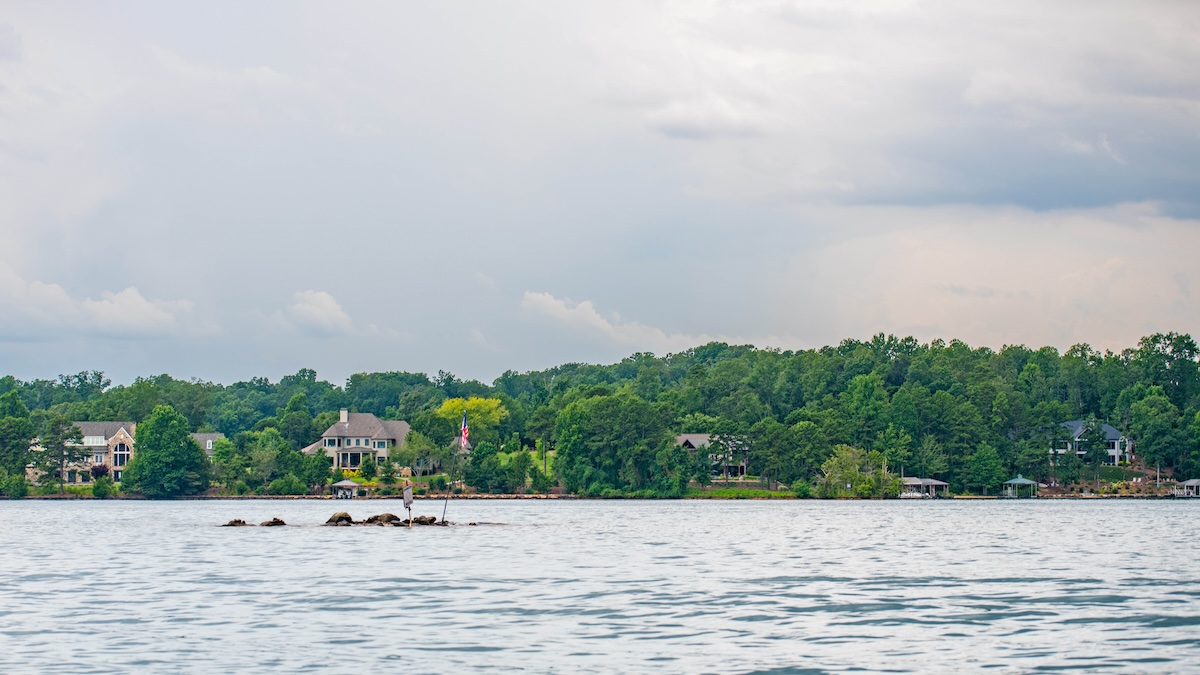
From the water, Lake Keowee unfolds cove by cove, its wooded points opening onto broad reaches of lake, with the first ridges of the Blue Ridge Mountains rising to the north. The lake lies in the foothills of Upstate South Carolina, where the mountains give way to the rolling Piedmont.
The lake dates to the early 1970s, when Duke Power dammed the Keowee and Little rivers, but its name reaches back centuries further, to a Cherokee town that stood beside the river in the valley now beneath the water.
Today, real estate on Lake Keowee, SC, covers waterfront homes, interior homes set back from the shoreline, and lots for building a home of your own. The lake’s private club communities include The Cliffs, The Reserve at Lake Keowee, and Keowee Key, each with golf, boating, and clubhouse amenities. Other homes and lots sit in neighborhoods and on individual parcels around the rest of the lake.
Across the lake, Duke Energy manages the water and shoreline under a plan designed to protect Lake Keowee’s natural resources and keep the lake open to the public and to property owners. South Carolina also assesses a primary residence at a lower property tax ratio than a second home, an added benefit for those who make real estate on Lake Keowee their full-time home.
Where Lake Keowee is located
Lake Keowee spans Oconee and Pickens counties in the northwestern corner of South Carolina, west of Greenville.1 Seneca and Salem sit on the Oconee County side of the lake, Sunset lies on the Pickens County side, and Clemson University is a short drive from the lake’s southern end.
Upstream, Lake Jocassee sits higher in the mountains, and the two lakes are linked through Duke Energy’s Keowee-Toxaway hydroelectric project.2 Around Jocassee, the Jocassee Gorges protect tens of thousands of acres of forest where the Blue Ridge drops toward the Piedmont, a landscape of rivers, waterfalls, and hiking trails.3
The history of Lake Keowee
Duke Power, now Duke Energy, created Lake Keowee in the early 1970s by damming the Keowee and Little rivers, and it built Lake Jocassee upstream during the same era.1,4,5 The lake supports hydroelectric generation, serves as the cooling reservoir for the Oconee Nuclear Station, and was built to provide public recreation as well as power.1,4
The valley beneath the water holds a much older story. The Cherokee town of Keowee, the largest of the Cherokee Lower Towns, stood along the Keowee River, and in the 1750s a British colonial fort, Fort Prince George, was built across the river from it. Before the lake filled, a University of South Carolina team excavated the fort site, which now lies beneath the lake.5
Some artifacts recovered from that excavation are held at the Pickens County Museum of Art and History.5 The lake itself carries the name of the Cherokee town, and the trails at nearby Keowee-Toxaway State Park cross land the Cherokee once traveled.3
How Duke Energy manages the lake and shoreline
Duke Energy owns and operates Lake Keowee under a license from the Federal Energy Regulatory Commission (FERC). It administers the Keowee-Toxaway Shoreline Management Plan, which guides construction, shoreline stabilization, and excavation within the FERC project boundary, the land and water area covered by the license, on Lake Keowee and Lake Jocassee. The plan aims to keep the lakes accessible to the public and to private owners while protecting their natural resources.2
For property owners, that means docks, piers, and shoreline work within the project boundary go through Duke Energy’s permitting process, and Duke accepts applications online through its Lake Access Permit System.6 Duke also publishes shoreline classification maps for Lake Keowee that show how each stretch of shoreline is classified under the plan, and a property’s classification can affect what may be built along its frontage.2
Duke Energy’s Lake Services team answers property-specific questions about docks, shoreline stabilization, and permits at LakeServices@duke-energy.com or 800-443-5193.2 Reviewing the shoreline classification maps and confirming dock options with Lake Services can be part of the research on any waterfront lot.
Duke Energy also manages the lake’s water level. Full pond, the lake’s normal full level, sits at 800 feet above sea level, and Duke posts current lake levels online.1,7 Comparing the depth at the end of a dock with that day’s level shows how a property’s frontage will work for boating, swimming, and everyday time on the water.
Types of Lake Keowee real estate
Real estate on Lake Keowee falls into four broad categories: waterfront homes, interior homes, waterfront lots, and interior lots. Waterfront property has frontage directly on the lake. Interior property sits off the water, either inside a community that may offer shared lake amenities such as a marina or community docks, or in a nearby neighborhood with access to public boat ramps and parks.
Each category follows its own pricing pattern. In Western Upstate MLS sales data from recent years, waterfront property on the lake has carried a substantial premium over interior property, and in percentage terms that premium has been larger for land than for homes. One likely reason is what is being bought: a lot’s value rests heavily on its location and frontage, while a home’s price also reflects the house itself.
| Property type | What it is | Points to research |
|---|---|---|
| Waterfront homes | A home with frontage directly on the lake, which may include a private dock | Dock condition and permits, water depth, shoreline orientation and views, community rules |
| Interior homes | A home off the water, inside a lake community or in a nearby neighborhood | Community lake access and marina options, views, HOA and club terms |
| Waterfront lots | Land with lake frontage for a future home | Shoreline classification and dock options, topography, utilities, building requirements |
| Interior lots | Off-water land inside or near a lake community | Architectural review, utilities, community lake access, any building timelines |
Land and finished homes also tend to sell at different speeds. In the same sales data, lots have generally spent longer on the market than homes, and homes have typically closed closer to their final asking price. For sellers of a lot, recent sales of comparable land offer a clear guide to pricing. For buyers, the same pattern can mean more room to negotiate on land, along with the opportunity to build a lake home from the ground up.
Communities around Lake Keowee
The Cliffs at Lake Keowee, The Reserve at Lake Keowee, and Keowee Key are gated club communities on the lake, each with its own club, amenities, and governing documents. Buying in one involves reviewing that community’s membership and homeowners association (HOA) terms along with the property itself.
A large share of the lake’s recent home and land sales have taken place outside those three communities, in the many other neighborhoods, subdivisions, and individual parcels around the shoreline. That range gives buyers a wide choice of settings, from homes inside amenity-rich private communities to land with no community club at all.
The Cliffs at Lake Keowee
The Cliffs is a group of private club communities in the Carolinas, three of them on Lake Keowee: The Cliffs at Keowee Vineyards, The Cliffs at Keowee Falls (South and North), and The Cliffs at Keowee Springs. Amenities across the three include golf, a marina, and wellness facilities.
The Reserve at Lake Keowee
Located in Sunset on the lake’s Pickens County side, The Reserve at Lake Keowee is a private golf and boating community with a Jack Nicklaus Signature golf course.8 It now carries the Old Edwards name, shared with Old Edwards Club in Highlands, North Carolina.9
Keowee Key
The homes in Keowee Key make up a gated community in Salem whose history dates to 1972, when plans for a resort community on the new lake were announced. Its members bought the community in 1987 and govern it through a volunteer board. Amenities include an 18-hole golf course, marinas, a clubhouse, and fitness and racquet facilities, and homes range from single-family houses to condominiums and townhomes.10
Other neighborhoods and individual parcels
Many of the lake’s homes and lots sit outside the three communities above, in other subdivisions, established neighborhoods, and individually owned parcels. Some have their own HOAs, covenants, and shared docks, while others offer the freedom of an independent parcel with few restrictions, for buyers who want a lake home on their own terms.
Buying waterfront real estate on Lake Keowee
Waterfront property on Lake Keowee involves research beyond a standard home inspection. Docks and shoreline improvements fall under Duke Energy’s shoreline management plan, community covenants can add requirements of their own, and the water in front of a property ranges from open frontage on the main body of the lake to quieter, often shallower coves.
Much of this research can take place during the inspection or due diligence period, the window after an accepted offer when a buyer investigates the property before closing. Shoreline classification and dock options can also be reviewed before an offer, which is useful on a waterfront lot where a future dock is part of the plan.
Check the shoreline classification
Duke Energy’s shoreline classification maps show how the frontage along a property is classified under the Keowee-Toxaway Shoreline Management Plan, which can affect whether a new dock or other shoreline work may be permitted along that stretch of the lake.
Review the existing dock
For a property with a dock, the dock’s condition and whether past work on it went through Duke Energy’s permitting process are part of the review, since maintaining or modifying a dock also falls under Duke’s permitting.
Measure the water depth
Depth at the end of a dock depends on the slope of the shoreline and the lake level relative to full pond. Recording the depth along with that day’s lake level gives a clearer picture of how the frontage will work for a boat.
Read the community documents
Covenants, architectural guidelines, HOA dues, and club membership terms vary from one community to the next. In private club communities, the club’s current membership documents spell out what membership includes, what it requires, and what it costs.
Compare similar recent sales
The most relevant price comparisons come from recent sales of the same property type in the same community or a similar setting on the lake. A waterfront home in a private club community, for example, is best compared with other waterfront homes in that community.
These steps describe general research, and every lake property has its own character, from the slope of its shoreline to the amenities of its community. Consulting with a Lake Keowee real estate professional can help you greatly in researching how these things apply to specific homes or lots, and keep the focus on finding the perfect place on the water.
Buying land and building on the lake
Lots around Lake Keowee range from gentle grades to steep, wooded slopes that fall toward the water. Topography shapes where a house can sit, how it steps down toward the lake, and how much grading and foundation work it requires, so a lot’s buildable area and its acreage are both part of evaluating it.
Recent years of sales on the lake have shown wider swings for land than for homes in how long it takes to sell. A single year’s days-on-market figure for lots can differ noticeably from the year before, so comparing several years side by side gives a steadier view of how land is moving on the lake.
Inside private communities, plans for a new home may go through an architectural review board, a committee that approves home designs before construction begins, and some communities set standards for materials, size, or the timeline for building. Utilities, road access, and, on waterfront lots, the shoreline classification also influence what a lot can support. A builder who knows the lake can estimate site costs before a purchase closes and help design a home that makes the most of its setting.
How to read the Lake Keowee real estate market
A handful of common measures describe the Lake Keowee real estate market, and each one answers a different question. Broken out by property type and by community, they show patterns that a single lake-wide average can hide.
- Average sale price. The mean closing price for a category or community. A few high-end sales can pull it upward, especially where closings are few.
- Sale-to-ask ratio. The closing price as a percentage of the final asking price, which shows how much negotiation took place at the end of a listing.
- Days on market. The average number of days listings spent on the market before selling, a measure of how quickly a category is moving.
- Market share. The portion of a category’s sales that took place in a given community.
- Pending sales. Properties under contract that have not yet closed, which offer an early look at what is ahead.
- Active listings. Properties currently for sale. Set against the recent pace of sales, they give a rough sense of supply in a community.
Community-level figures depend heavily on sample size. With a limited number of closings in any one community over a short period, a single large sale can move an average sharply in either direction, so a price change for one neighborhood reads best alongside the number of sales behind it.
These measures describe the market as a whole, and the value of a specific home or lot also depends on its frontage, views, condition, and community. For a particular property, a real estate professional who knows the lake’s communities can put current figures in context and show how its strengths compare with recent sales nearby.
Property taxes on primary and second homes
South Carolina calculates property tax from an assessed value, a percentage of the property’s fair market value, multiplied by the local tax rate, known as millage. That percentage, called the assessment ratio, depends on how the property is used, which is what separates a primary residence from a second home on the lake for tax purposes.11
Lake Keowee spans Oconee and Pickens counties, so the assessor’s office that handles a property depends on which county it sits in, and tax rates vary by county and local taxing district. Renting a home can affect its eligibility for the lower residential ratio, and the Department of Revenue’s guide to legal residence describes the kinds of proof of residency an assessor may request.11,12 This is general tax information, and the county assessor’s office or a tax professional can confirm how it applies to a specific property.
South Carolina assesses an owner-occupied legal residence at 4 percent of fair market value, on up to five contiguous acres, and a second home or vacation home at 6 percent. For owners who make Lake Keowee their primary residence, the lower ratio, once the county assessor approves it, means a lower assessed value and a lower tax bill than the same home would carry as a second home.11
Life on Lake Keowee
Boating, fishing, swimming, sailing, and paddling are part of everyday life on Lake Keowee for many of our neighbors, and bass fishing is among the most popular activities on the water according to the South Carolina Department of Natural Resources.1 Our lake’s waters are often described as clear (or as emerald/sapphire-colored, depending on the weather and time of year!) and Duke Energy and the county maintain public boat ramps around the shoreline.4,13

Two Oconee County parks in Seneca, South Cove and High Falls, offer boat ramps, fishing piers, and lakeside camping.13 Keowee-Toxaway State Park in Sunset adds hiking trails, shoreline fishing, and a rental cabin with a porch overlooking the lake, and its Jocassee Gorges Visitor Center introduces the protected mountain lands to the north.3
Beyond the shoreline, Clemson University brings college athletics and the performing arts to the area, and Seneca’s historic downtown sits near the lake’s southern end. Lake Jocassee and the waterfalls and trails of the Jocassee Gorges lie to the north, and Greenville’s restaurants, shops, and airport are within driving distance to the east.
The lake also has an active stewardship community. The Friends of Lake Keowee Society, a nonprofit founded in 1993, focuses on protecting the lake and its watershed, has run lake cleanups and habitat projects for years, and has monitored water quality for decades.7
Selling a home or lot on Lake Keowee
Pricing a lake property depends on finding the right comparisons. A waterfront home in a private club community, an interior home in an established neighborhood, and a waterfront lot on an independent parcel each draw on a different set of recent sales, and results in one community can diverge sharply from the lake-wide average.
For waterfront property, records of dock permits and any approved shoreline work through Duke Energy help answer buyer questions, as do the HOA or club documents that describe membership and transfer terms. Pending sales by category and community show where buyer interest is strongest, and with that information in hand, a seller can present a lake property’s strengths with confidence.
Frequently asked questions about Lake Keowee real estate
Q: Who owns Lake Keowee?
A: Duke Energy owns and operates the lake under a license from the Federal Energy Regulatory Commission. Docks and other construction within the licensed project boundary go through Duke’s Keowee-Toxaway Shoreline Management Plan, which is designed to keep the lake accessible while protecting its natural resources.
Q: Which counties is Lake Keowee in?
A: Oconee and Pickens counties. Seneca and Salem are on the Oconee County side, and Sunset is on the Pickens County side.
Q: Can a dock be built on any Lake Keowee waterfront lot?
A: Dock options depend on the shoreline classification along the lot and on Duke Energy’s permit requirements. Duke publishes shoreline classification maps for the lake, and its Lake Services team answers questions about individual properties.
Q: What does full pond mean?
A: Full pond is a reservoir’s normal full water level. On Lake Keowee it is 800 feet above sea level, and the level on any given day can differ from it. Duke Energy publishes current lake levels online.
Q: How does interior property differ from waterfront property?
A: Waterfront property has frontage directly on the lake, and interior property sits off the water. Interior homes and lots inside lake communities may still come with lake access through a shared marina or community docks. In recent years of sales on the lake, interior homes and lots have sold for considerably less than waterfront property, making them a more accessible way to enjoy life on Lake Keowee.
Q: Are property taxes higher on a second home?
A: Yes. South Carolina assesses a second or vacation home at 6 percent of fair market value, compared with 4 percent for an owner-occupied legal residence, and the final bill for either reflects the local millage rate. Owners who make the lake their primary residence can apply to the county assessor for the lower ratio.
Q: How long do homes and lots take to sell on Lake Keowee?
A: It varies by property type, community, and year. In recent sales, homes have generally sold faster than lots and closer to their final asking price, while land has given buyers more room to negotiate and more time to find the right homesite.
Q: Is there public access to Lake Keowee?
A: Public access points include South Cove and High Falls county parks in Seneca, Keowee-Toxaway State Park in Sunset, and boat ramps maintained by Duke Energy and Oconee County. Both county parks also offer lakeside camping, a relaxed way to spend a few days on the water.
Current Lake Keowee real estate market information, from recent home and lot sales to pending sales and active listings, helps buyers compare properties and helps sellers price a home or lot.
The Cason Group of Keller Williams Lake Keowee publishes a quarterly Lake Keowee real estate market report, along with an end-of-year edition, compiled from Western Upstate MLS data. It covers waterfront homes, interior homes, waterfront lots, and interior lots across The Cliffs, The Reserve, Keowee Key, and the rest of our local real estate market. Sign up for the Lake Keowee market report to have each new edition sent to your inbox!
To talk with The Cason Group about buying or selling Lake Keowee real estate, call 864-903-1234 or click here to get in touch!
References
1. Lake Keowee. South Carolina Department of Natural Resources.
2. Keowee-Toxaway Shoreline Management Plan. Duke Energy.
3. Keowee-Toxaway State Park Trails. South Carolina State Parks.
4. Lake Keowee. Visit Oconee SC.
5. Diving Deep: The Hidden History Beneath Our Upstate SC Lakes. Greenville Journal.
6. Permits for Shoreline Activities. Duke Energy.
7. About the Friends of Lake Keowee Society. FOLKS.
8. Bay Point Advisors Funds $15.5M Debt and Preferred Equity Investment for Acquisition of the Reserve at Lake Keowee. Business Wire.
9. Old Edwards Reserve at Lake Keowee. The Laurel Magazine.
10. Senate Resolution S. 1341 recognizing Keowee Key’s fiftieth anniversary. South Carolina General Assembly.
11. Chapter 5: Individual Property Taxes. South Carolina Department of Revenue.
12. Homeowner’s Guide to Legal Residence in South Carolina. South Carolina Department of Revenue.
13. County Parks. Visit Oconee SC.
This article provides general information about Lake Keowee real estate and is not legal, tax, or financial advice. For guidance on a specific property, consult a Lake Keowee real estate professional, along with an attorney or tax advisor as needed. Market observations are drawn from Western Upstate MLS sales data, and county assessors determine eligibility for the legal residence ratio.